
BLACK HISTORY MONTH SPOTLIGHT
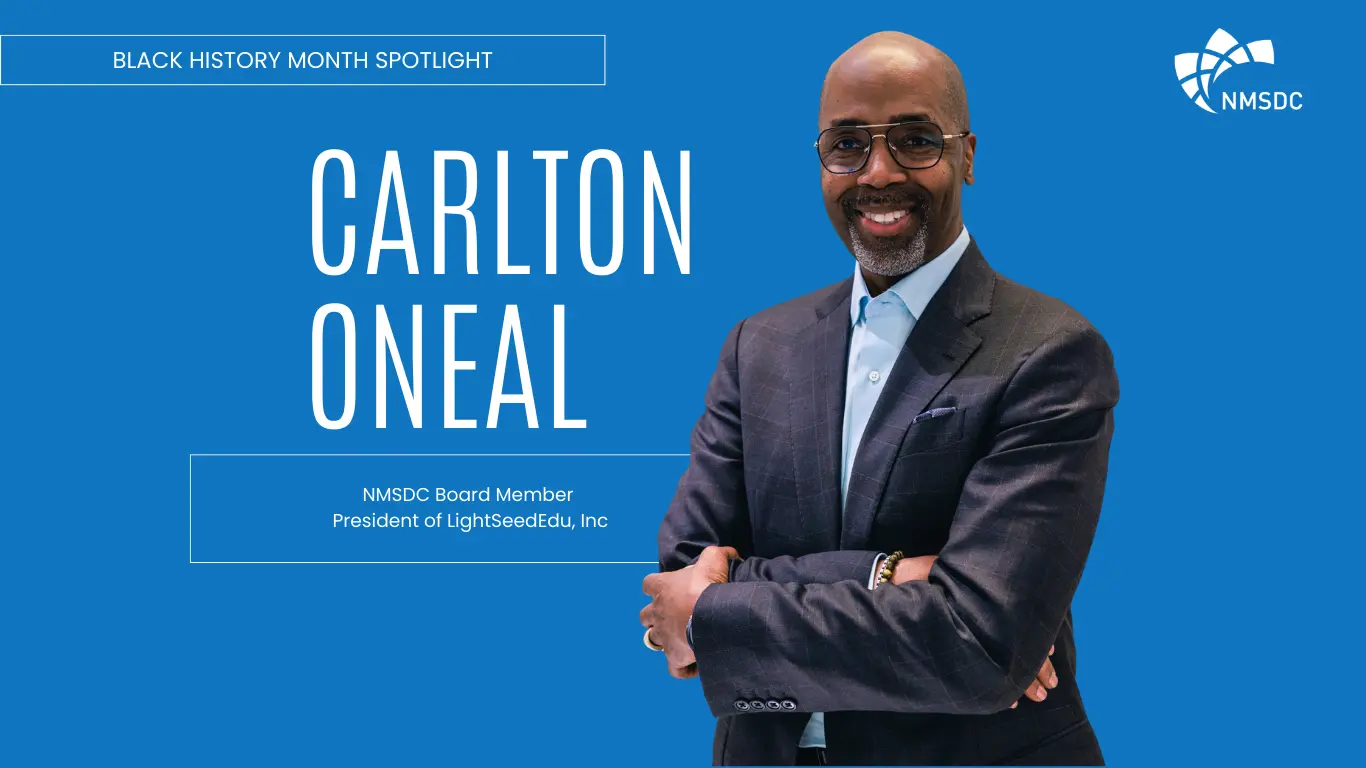
Carlton Oneal Feature Story– NMSDC Board Member and President of LightSeedEdu, Inc.
As a Board Member of NMSDC, what impact are you most proud of through your work, and what gives you hope when you look at the next generation of Black leaders?
I’m most proud of the role I’ve played in shaping strategy by bringing the MBE perspective into rooms where decisions are made. Over the years, I have moved from local leadership to regional work and eventually to the national board, and one thing has remained consistent: my role has always been to ensure the voice of the MBE is heard when real decisions are made. Before NMSDC board meetings, I take time to connect with MBE peers to ensure I’m representing the broader community. That means elevating MBE concerns around access, accountability, decision-making, and long-term sustainability.
What gives me hope is what I’m seeing in the next generation of leaders, especially around technology, data, and collaboration. Younger MBE leaders are pushing to make sure their knowledge and influence are felt, and they’re investing in how technology and data can strengthen decision-making. I’m also encouraged by how often I now hear leaders talking about partnering, teaming, and building toward the global marketplace — because the future belongs to those who collaborate and scale together.
NMSDC’s commitment to advancing economic opportunity for Black-owned and other minority business enterprises is unwavering — how do you see that mission evolving right now?
NMSDC’s mission remains unwavering, and that consistency is especially important during a time of uncertainty across the broader landscape. What is evolving is how the mission is being activated. For many years, NMSDC was viewed primarily as a gateway for access, and access still matters, but MBEs come to the table already capable, competitive, and prepared. The focus now is on translating access into meaningful, sustained revenue growth.
This approach strengthens outcomes on all sides. It supports long-term business sustainability for MBEs, drives value and innovation to the economy, and reinforces an ecosystem built on accountability, opportunity, and mutual growth.
What role do you believe supplier diversity plays in strengthening long-term economic competitiveness for Black-owned businesses?
Supplier diversity plays a direct role in competitiveness when it’s approached as a growth strategy. The strongest MBEs are already table-competitive, but competitiveness expands when MBEs are positioned
for larger opportunities and long-term relationships. A key driver of that is collaboration and teaming. You get the best results when MBEs are brought together as a team.
When corporations truly support this model, they’re not just “helping” MBEs — they’re strengthening their own outcomes. They’re getting the best of what’s out there, delivered by diverse partners working together. Those who are truly intentional recognize that MBEs deliver resilience, innovation, and performance, especially when they’re integrated into real work, not small side projects.
From your perspective, what are the biggest opportunities today for Black-owned MBEs in innovation, growth, and scale?
The biggest opportunity today is at the intersection of technology, services, and problem-solving and proving that MBEs can impact corporations from all of those angles. I’m hearing more MBEs talk about investing in digital infrastructure, data-driven decision-making, and specialized expertise. At the same time, growth and scale increasingly come from being strategic about partnerships. Technology and partnerships allow MBEs to show they have both the capability and the capacity to deliver.
There’s also a mindset shift that must happen. Some corporations still assume MBEs are small and question whether they can “get the job done,” but that’s simply not accurate. There are MBEs that are billion-dollar businesses, and there are many others who can come together and demonstrate scale. The opportunity is for MBEs to leverage technology and collaboration to close that perception gap, and for corporate decision-makers to stop limiting MBEs to small projects and instead provide opportunities that enable businesses to scale.
If you could leave our audience with one call to action this month, what would it be?
My call to action is to apply the lessons we learned during the pandemic. During that period, traditional supply chains broke down, and minority businesses stepped up and demonstrated innovation, speed to market, and the ability to pivot. Corporations relied on MBEs and MBEs delivered, and we heard countless success stories. But when things calmed down, too many organizations went right back to old habits.
That’s why the call to action is to stop and ask: what did we learn? We already knew MBEs strengthen resilience, reduce risk, drive innovation, and create competitive advantage, and we proved it. The work now is to be intentional about expanding opportunity beyond the “small project on the side,” because most MBEs don’t want to be put in a box; they want to compete, and they need to, and they can.
Economic impact is created when opportunity aligns with readiness, discipline, intentionality, and vision, and when businesses commit to building supply chains that are resilient, adaptive, and built for long-term success.